


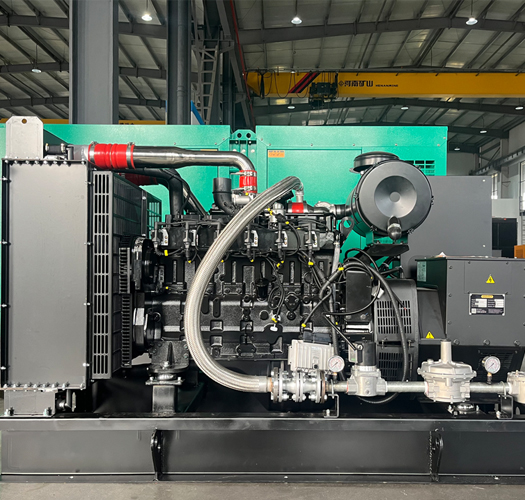
Under the guidance of the "dual carbon" goal, natural gas, as a clean and low-carbon transitional energy source, its generating units occupy an important position in peak regulation, power guarantee and distributed energy supply of the new power system. As a core indicator to measure the economy of natural gas generating units and determine their market promotion and application scope, power generation costs are affected by multiple factors such as gas source price, equipment investment, operation and maintenance level, and policy mechanisms, showing significant structural characteristics. This article comprehensively decomposes and analyzes the power generation costs of natural gas generating units from four core dimensions: core cost composition, key influencing factors, current industry cost status and optimization directions, providing reference for industry project layout and enterprise decision-making.
I. Core Composition of Power Generation Costs
The power generation cost of natural gas generating units takes the full-life-cycle levelized cost of electricity (LCOE) as the core accounting indicator, covering three core sectors: fuel cost, construction investment cost and operation and maintenance cost. The proportion of the three shows obvious differential distribution, among which fuel cost dominates and directly determines the overall cost level.
(I) Fuel Cost: Core of Cost Proportion, Most Significant Impact from Fluctuations
Fuel cost is the largest proportion of the power generation cost of natural gas generating units. Industry calculation data shows that its proportion generally reaches 60%-80%, and can exceed 80% in some extreme market environments, making it the most critical variable affecting the fluctuation of power generation costs. The accounting of fuel cost mainly depends on the natural gas price (including purchase price and transmission and distribution fee) and unit power generation efficiency. The core calculation formula is: Fuel Cost (yuan/kWh) = Natural Gas Unit Price (yuan/cubic meter) ÷ Unit Power Generation Efficiency (kWh/cubic meter).
Combined with the current mainstream industry level, the average domestic natural gas price to the plant is about 2.8 yuan/cubic meter. The power generation efficiency of typical combined cycle gas turbine (CCGT) units is about 5.5-6.0 kWh/cubic meter, corresponding to the unit power generation fuel cost of about 0.47-0.51 yuan; if distributed internal combustion engine units are adopted, the power generation efficiency is about 3.8-4.2 kWh/cubic meter, and the unit power generation fuel cost rises to 0.67-0.74 yuan. It is worth noting that about 40% of domestic natural gas depends on imports. Fluctuations in international LNG spot prices and changes in the domestic gas source production, supply, storage and marketing pattern will be directly transmitted to the fuel cost end. For example, during the sharp rise in Asian JKM spot prices in 2022, the unit power generation fuel cost of domestic gas-fired power enterprises once exceeded 0.6 yuan, far exceeding the break-even range.
(II) Construction Investment Cost: Stable Proportion of Fixed Investment, Decline Aided by Localization
Construction investment cost is a one-time fixed investment, mainly including equipment purchase, civil engineering, installation and commissioning, land acquisition and financing costs. Its proportion in the full-life-cycle power generation cost is about 15%-25%, and the core influencing factors are equipment technical level and localization rate.
From the perspective of equipment purchase, the core technology of heavy-duty gas turbines has long been monopolized by international giants, and the prices of imported equipment and key components remain high. The unit kilowatt static investment cost of a single million-kilowatt combined cycle power generation project is about 4500-5500 yuan, among which the gas turbine and supporting waste heat boiler account for about 45% of the total equipment investment. In recent years, domestic enterprises have accelerated technological breakthroughs. Enterprises such as Weichai Power and Shanghai Electric have gradually realized the localization of medium and light-duty natural gas generating units and core components, reducing the purchase cost of similar equipment by 15%-20% compared with imported products, effectively lowering the overall construction investment cost. In addition, unit capacity and installation scenarios also affect construction costs. Distributed small units have short installation cycles (only 2-3 months), low civil engineering investment, and lower unit kilowatt investment costs than large centralized power stations; although large combined cycle units have high initial investment, they have significant advantages in power generation efficiency and can amortize unit investment costs through large-scale power generation.
(III) Operation and Maintenance Cost: Long-term Continuous Investment, Great Room for Technological Optimization
Operation and maintenance cost is a continuous investment in the full life cycle, mainly including equipment inspection and maintenance, parts replacement, labor cost, lubricating oil consumption, environmental protection treatment, etc. Its proportion in the full-life-cycle power generation cost is about 5%-10%. From the perspective of industry practice, the core expenditure of operation and maintenance cost is the replacement of key components and maintenance services, among which the medium maintenance cost of a single large gas turbine can reach 300 million yuan, and the replacement cost of core components is relatively high.
Units with different technical levels have significant differences in operation and maintenance costs: although high-performance generating units have higher initial investment, their lubricating oil consumption is only 1/10 of that of ordinary units, with longer oil change cycles and lower probability of failure shutdown, which can effectively reduce labor costs and shutdown losses; on the contrary, technologically backward units have frequent failures, which not only increase the cost of parts replacement, but also affect power generation revenue due to shutdown, indirectly pushing up the comprehensive cost. In recent years, with the upgrading of localized operation and maintenance technology and the application of intelligent diagnosis systems, the operation and maintenance costs of domestic natural gas generating units have gradually decreased. The improvement of the independent maintenance rate of core components has reduced the replacement cost by more than 20%, and the maintenance interval has been extended to 32,000 hours, further compressing the space for operation and maintenance expenditure.
II. Key Variables Affecting Power Generation Costs
In addition to the above core components, the power generation costs of natural gas generating units are also affected by multiple variables such as gas price mechanism, policy orientation, carbon market development, regional layout and unit utilization hours, among which the impact of gas price mechanism and carbon market development is the most far-reaching.
(I) Gas Price Mechanism and Gas Source Guarantee
The stability of natural gas prices and procurement models directly determine the trend of fuel costs, and then affect the overall power generation costs. At present, the domestic natural gas price has formed a linkage mechanism of "benchmark price + floating price". The benchmark price is linked to international crude oil and LNG prices, and the floating price is adjusted according to market supply and demand. Price fluctuations are directly transmitted to the power generation cost end. Gas source guarantee capacity also affects costs. In load center regions such as the Yangtze River Delta and the Pearl River Delta, LNG receiving stations are dense, the level of pipeline network interconnection is high, the transmission and distribution cost is low, the gas source supply is stable, and the fuel cost is relatively controllable; while in the northwest region, limited by gas source distribution and transmission and distribution facilities, the natural gas transmission and distribution cost is relatively high, pushing up the power generation cost of generating units in the region. In addition, enterprises can lock in gas source prices by signing long-term gas supply agreements, effectively avoiding the cost risks caused by fluctuations in international gas prices.
(II) Policy Orientation and Market Mechanism
Policy mechanisms mainly affect the comprehensive costs and revenue levels of natural gas generating units through cost transmission and revenue compensation. In recent years, China has gradually promoted the reform of the two-part electricity price for natural gas power generation, which has been first implemented in provinces such as Shanghai, Jiangsu and Guangdong. The fixed cost recovery is guaranteed through the capacity price, and the energy price is linked to the gas price to transmit fuel costs. Among them, Guangdong has raised the capacity price from 100 yuan/kW/year to 264 yuan/kW/year, which can cover 70%-80% of the fixed costs of the project, effectively alleviating the problem of cost transmission. At the same time, the compensation policy for fast start-stop units in the auxiliary service market has further improved the revenue structure of gas-fired power projects. The peak regulation compensation price in some regions has reached 0.8 yuan/kWh, which is significantly higher than the conventional power generation revenue.
(III) Carbon Market Development and Low-Carbon Advantages
With the continuous improvement of the national carbon emission rights trading market, carbon costs have gradually been internalized, becoming an important factor affecting the relative economy of natural gas generating units. The unit carbon dioxide emission intensity of natural gas generating units is about 50% of that of coal-fired power (about 380 grams of CO₂/kWh vs. about 820 grams of CO₂/kWh for coal-fired power). Against the background of rising carbon prices, its low-carbon advantages continue to be prominent. The current domestic carbon price is about 50 yuan/ton of CO₂, and it is expected to rise to 150-200 yuan/ton by 2030. Taking a single 600,000-kilowatt unit with an annual emission of about 3 million tons of CO₂ as an example, coal-fired power will need to bear an additional 450-600 million yuan of carbon costs per year at that time, while gas-fired power is only 40% of that of coal-fired power, and the cost gap between gas-fired power and coal-fired power will be further narrowed. In addition, gas-fired power projects can achieve additional revenue by selling surplus carbon quotas in the future, which is expected to reduce the full-life-cycle levelized cost of electricity by 3%-5%.
(IV) Unit Utilization Hours
Unit utilization hours directly affect the amortization effect of fixed costs. The higher the utilization hours, the lower the unit power generation cost. The utilization hours of natural gas generating units are closely related to the application scenarios: centralized power stations, as peak regulation power sources, generally have utilization hours of 2500-3500 hours; distributed power stations, which are close to the terminal load demand of industrial parks and data centers, can reach utilization hours of 3500-4500 hours, and the unit power generation cost can be reduced by 0.03-0.05 yuan/kWh. If the utilization hours are less than 2000 hours, the fixed costs cannot be effectively amortized, which will lead to a significant increase in the comprehensive power generation cost and even losses.
III. Current Industry Cost Status
Combined with current industry data, under the benchmark scenario of natural gas price of 2.8 yuan/cubic meter, utilization hours of 3000 hours and carbon price of 50 yuan/ton of CO₂, the full-life-cycle levelized cost of electricity of typical combined cycle gas turbine (CCGT) projects is about 0.52-0.60 yuan/kWh, slightly higher than that of coal-fired power (about 0.45-0.50 yuan/kWh), but significantly lower than the comprehensive cost of renewable energy with energy storage (about 0.65-0.80 yuan/kWh).
From the perspective of regional differences, benefiting from stable gas source supply, improved policy support and high carbon price acceptance, the full-life-cycle levelized cost of electricity of gas-fired power plants in load center regions such as the Yangtze River Delta and the Pearl River Delta can be controlled at 0.45-0.52 yuan/kWh, which has an economic basis for competition with coal-fired power; among them, as a carbon trading pilot, Guangdong's average carbon price in 2024 reached 95 yuan/ton, combined with the capacity compensation mechanism, the cost advantage is more obvious. In the northwest region, limited by gas source guarantee and transmission and distribution costs, the unit power generation cost is generally higher than 0.60 yuan/kWh, and the project economy is weak.
From the perspective of the industry as a whole, the power generation cost of natural gas generating units shows an optimization trend of "low in the short term and improving in the long term": in the short term, due to high gas prices and low utilization hours in some regions, the profit space is limited; in the medium and long term, with the diversification of gas sources, localization of equipment, rise of carbon prices and improvement of policy mechanisms, the cost will gradually decrease. It is expected that by 2030, the internal rate of return (IRR) of efficient gas-fired power projects with carbon asset management capabilities will be stably in the range of 6%-8%.
IV. Core Directions for Cost Optimization
Combined with cost composition and influencing factors, the optimization of power generation costs of natural gas generating units needs to focus on the four cores of "controlling fuel, reducing investment, optimizing operation and maintenance, and enjoying policies", and realize the continuous reduction of comprehensive costs through technological innovation, resource integration and policy connection.
First, stabilize gas source supply and control fuel costs. Strengthen cooperation with major domestic natural gas suppliers, sign long-term gas supply agreements to lock in gas source prices; promote the diversified layout of gas sources, rely on the increase of domestic shale gas production and the improvement of LNG import long-term agreements to reduce dependence on international spot gas prices; at the same time, optimize the unit combustion system, improve power generation efficiency, and reduce fuel consumption per unit power generation.
Second, promote equipment localization and reduce construction investment. Continuously increase investment in core technology research and development, break through the bottleneck of localization of key components of heavy-duty gas turbines, and further reduce equipment purchase costs; optimize project design and installation processes, shorten the construction cycle, and amortize financing costs and civil engineering investment; reasonably select unit capacity according to application scenarios to achieve a balance between investment and efficiency.
Third, upgrade the operation and maintenance model and compress operation and maintenance costs. Build an intelligent diagnosis platform, rely on big data and 5G technology to realize accurate early warning of equipment health status, and promote the transformation of the operation and maintenance model from "passive maintenance" to "active early warning"; promote the localization of operation and maintenance technology, set up a professional operation and maintenance team, improve the independent maintenance capacity of core components, and reduce maintenance and parts replacement costs; select high-performance units to reduce the probability of failure shutdown and consumable consumption.
Fourth, accurately connect with policies and tap additional revenue. Actively respond to policies such as the two-part electricity price and peak regulation compensation, and strive for cost transmission and revenue compensation support; proactively layout the carbon asset management system, make full use of the carbon market mechanism to achieve additional revenue by selling surplus carbon quotas and participating in carbon financial instruments, and further optimize the cost structure; promote the "gas-photovoltaic-hydrogen" multi-energy complementary layout, improve unit utilization hours, and amortize fixed costs.
V. Conclusion
The power generation cost of natural gas generating units is centered on fuel cost, supported by construction investment and operation and maintenance costs, and is jointly affected by multiple factors such as gas price, policy, carbon market and regional layout. Its economy depends not only on its own technical level and management capacity, but also on the in-depth binding of the energy market pattern and policy orientation. At present, although the power generation cost of natural gas generating units is slightly higher than that of coal-fired power, with the advancement of the "dual carbon" goal, the rise of carbon prices and the breakthrough of equipment localization, its low-carbon advantages and economic advantages will gradually be prominent.
In the future, with the continuous improvement of the natural gas production, supply, storage and marketing system and the deepening of the reform of the power market and carbon market, the power generation cost of natural gas generating units will be gradually optimized, becoming an important support for connecting high-proportion renewable energy and energy security. For industry enterprises, it is necessary to accurately grasp the factors affecting costs, focus on the core optimization directions, and continuously reduce the comprehensive power generation cost through technological innovation, resource integration and policy connection, improve the market competitiveness of natural gas generating units, and help the construction of the new power system and the transformation of the energy structure.
Post time: Feb-04-2026


